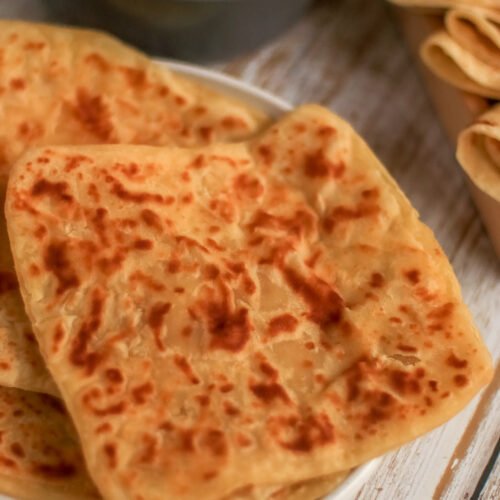
A soft, flaky square paratha made with just 5 ingredients. Same dough as roti, but the square fold is what creates those buttery layers. Quick to make once you get the hang of the fold and best eaten warm, straight off the tawa.
Equipment
- Large mixing bowl
- Rolling Pin
- Flat pan or tawa
- Clean cloth or kitchen towel
- Spatula
Ingredients
- 2½ cups (625ml) cake wheat flour
- 1 tbsp vegetable oil
- 150g margarine (1 tbsp for the dough mixture, 2–3 tbsp for spreading inside the dough before folding and the remainder for cooking on the tawa)
- ¼ tsp fine salt
- 1¾ cups (435ml) boiling water
Instructions
- In a large bowl, combine the cake wheat flour and salt. Add 2 tablespoons of melted margarine and the oil and mix through. Gradually pour in the boiling water, mixing as you go, until a soft dough comes together. You may not need all the water. Add just enough until the dough feels soft and pliable but not sticky.
- Knead for a few minutes until smooth, then cover with a clean cloth and leave to rest for at least 15–20 minutes. Don’t rush this part. Resting is what makes the dough easy to roll and the paratha soft when cooked.
- Divide the dough into equal portions, roughly the size of a golf ball.
- First, coat each ball of dough in a bowl of flour. Then, on a lightly floured surface, flatten each piece with your hand and roll each one out into a thin, even circle. Keep the portions you’re not working with covered with a cloth so they don’t dry out.
- Spread a generous layer of softened margarine over the surface of the rolled dough. Then fold it into a square. Fold the left third into the centre. Fold the right third over that. Fold the top third down and the bottom third up to form a neat square.
- You should now have a layered square of dough. Gently roll it out again into a thin square, not too aggressively, you want to keep those layers intact.
- Heat a flat pan or tawa over medium-high heat. Place the paratha onto the dry pan and cook for about 30–40 seconds until bubbles start forming on the surface. Flip and cook the other side. Spread melted margarine on both sides of the paratha. You’re looking for golden spots on both sides with a soft centre and slightly crispy edges.
- Stack the cooked parathas on a plate and cover with a clean cloth as you go. The steam that builds between them keeps them soft and warm while you finish the rest. Don’t leave them uncovered or they’ll dry out quickly and get tough.
Notes
- Rest the dough — don't skip this. At least 15–20 minutes is non-negotiable. Resting relaxes the gluten and is the difference between a dough that rolls out smoothly and one that keeps springing back.
- Use boiling water, not warm or cold. Boiling water partially cooks the flour and is what gives this soft and buttery square paratha its characteristic softness. Cold water will give you a tougher result.
- Don't overwork the dough. Knead just until smooth. Over-kneading develops too much gluten and makes the paratha tough rather than soft.
- Be generous with the margarine between the folds. This is what creates the flaky layers.
- Roll thin after folding — but gently. You want to maintain the layers you've created. Roll with even, gentle pressure rather than pressing hard.
- Your pan must be hot enough. A pan that isn't hot enough will dry the paratha out before it cooks properly. Medium-high heat is what you want. Bubbles should appear within seconds of the paratha hitting the pan.
- Cover your parathas as you cook. Stack them immediately and cover with a clean cloth. The steam trapped between them keeps them soft. This step is just as important as the cooking itself.